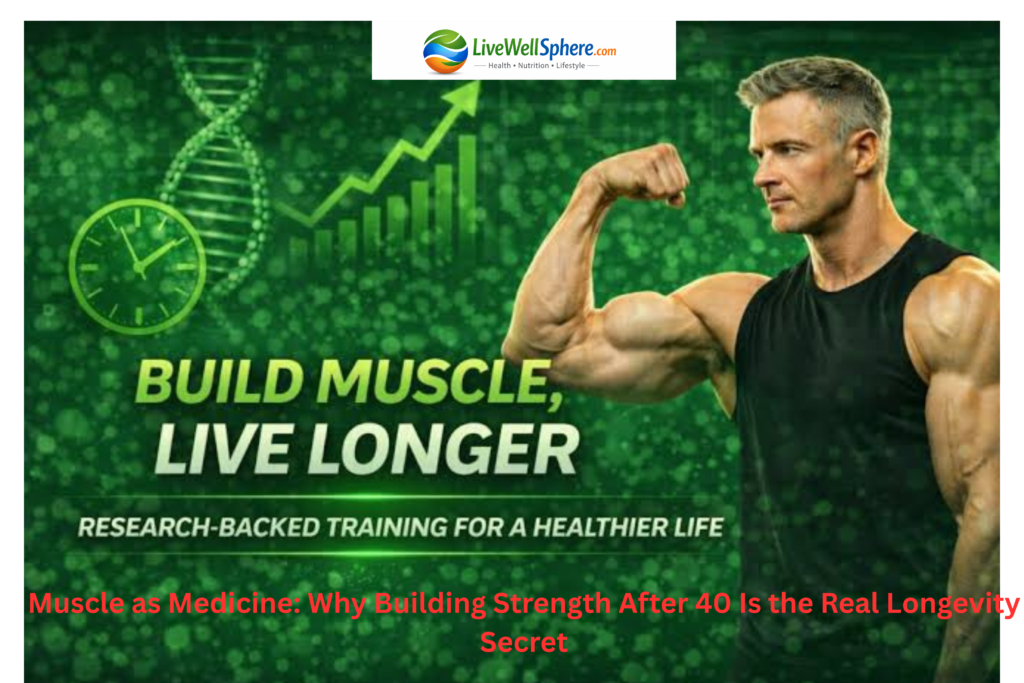
Muscle as Medicine: Why Building Strength After 40 Is the Real Longevity Secret
Ask most people what “longevity” means, and they’ll picture green smoothies, supplement stacks, or a strict eight-hour sleep window. Almost no one pictures a barbell.
That’s a problem, because a growing body of research suggests that the single strongest predictor of how long — and how well — you’ll live isn’t your diet, your genes, or even your cardio fitness. It’s your muscle mass and strength.
Doctors and longevity researchers have started calling it “muscle as medicine.” Not because lifting weights cures disease, but because the data connecting muscle mass to survival is now too consistent to ignore. People with more lean muscle and higher strength recover faster from illness, fall less often, keep their independence longer, and simply die at lower rates — at every age past 40.
This article breaks down why muscle matters so much for lifespan and healthspan, what happens to your body if you don’t train it, and exactly how to build strength in a way that protects you for decades, not just months.

The Silent Decline Nobody Talks About
Starting around age 30, most adults lose roughly 3 to 8 percent of their muscle mass per decade if they do nothing to stop it. That decline speeds up sharply after 60. Scientists call this process sarcopenia — age-related muscle loss — and it’s one of the quietest, most underdiagnosed conditions in modern medicine.
Sarcopenia doesn’t announce itself with a diagnosis or a blood test the way high cholesterol does. It shows up gradually: jars get harder to open, stairs feel steeper, a suitcase feels heavier than it used to. By the time people notice, they’ve often already lost a significant share of the muscle they’ll need for the rest of their life.
The consequences go far beyond convenience. Reduced muscle mass is linked to slower metabolism, poorer blood sugar control, weaker bones, higher fall risk, and longer hospital stays after surgery or illness. Muscle is also where your body stores much of its usable glucose and amino acid reserve — lose too much of it, and your body has fewer resources to draw on during illness, injury, or recovery.
Why Grip Strength Has Become a Longevity Biomarker
If you’ve read anything about longevity science recently, you may have come across an odd fact: doctors and researchers increasingly use a simple handgrip strength test as a predictor of overall mortality risk.
It sounds almost too simple to be meaningful, but multiple large population studies have found that grip strength correlates strongly with survival, cardiovascular health, and cognitive function in older adults. The logic isn’t that a stronger grip itself keeps you alive — it’s that grip strength is a convenient stand-in for overall muscular health, neuromuscular function, and physical resilience. A weak grip tends to reflect a body that has lost strength broadly, not just in the hands.
This is part of why some longevity clinics now include grip strength, sit-to-stand tests, and gait speed alongside blood panels and cholesterol checks. Strength has moved from being a “fitness metric” to being treated as a genuine vital sign.
Muscle Is Metabolically Active Tissue
One reason muscle has such an outsized effect on long-term health is that it isn’t passive tissue sitting on your frame — it’s one of the most metabolically active organs in your body.
Muscle tissue helps regulate blood sugar by soaking up glucose after meals. It plays a major role in your resting metabolic rate. It produces signaling molecules called myokines during exercise, which appear to have anti-inflammatory effects and communicate with the brain, liver, and immune system. Some researchers now describe skeletal muscle as an “endocrine organ” in its own right, releasing compounds that ripple out to nearly every system in the body.
When muscle mass shrinks, you lose more than strength — you lose a meaningful chunk of your body’s metabolic machinery. That’s part of why sarcopenia is so closely tied to insulin resistance, weight gain, and frailty in older adults, even in people who haven’t dramatically changed their diet.
The Falls Problem: Why Strength Protects Independence
Falls are one of the leading causes of injury-related death and loss of independence in older adults. What’s rarely discussed is how preventable much of this risk actually is.
Falls happen at the intersection of balance, reaction time, and strength. Weak leg muscles mean a stumble is more likely to become a fall, and a fall is more likely to result in a fracture, because weaker muscles and bones absorb impact poorly. A hip fracture in someone over 65 is a serious medical event — a significant share of people who experience one lose their ability to live independently afterward, and the following year carries elevated mortality risk.
Strength training directly addresses this chain of risk. Stronger legs and core muscles improve balance reactions, stronger bones (which respond to resistance training by increasing density) better withstand impact, and better overall coordination reduces the odds of falling in the first place. This is one of the clearest, most direct lines between a gym habit and staying out of a hospital bed decades from now.
It’s Not Just About Muscle Size — It’s About Function
An important distinction in longevity science is the difference between muscle mass and muscle function. You can have decent muscle size but poor strength and coordination if the tissue isn’t regularly challenged. This is why simply “staying active” through walking or light activity, while valuable, doesn’t fully substitute for resistance training.
Functional strength — the ability to stand up from a chair without using your hands, carry groceries up stairs, or catch yourself if you trip — depends on regularly loading your muscles against resistance. This is precisely what happens during strength training: weights, resistance bands, bodyweight exercises, or any activity that asks your muscles to work against meaningful resistance.
The encouraging part is that muscle remains remarkably responsive to training at almost any age. Research on adults well into their 80s and 90s has repeatedly shown meaningful strength gains after consistent resistance training programs, even in people who had never lifted weights before. Muscle tissue doesn’t “give up” on you — it responds to the demands you place on it, at almost any starting point.
Protein’s Underrated Role
Strength training alone isn’t enough — muscle needs raw material to rebuild and grow. As people age, their bodies also become less efficient at using dietary protein to build muscle, a phenomenon researchers sometimes call “anabolic resistance.” This means older adults often need proportionally more protein than younger adults just to maintain the muscle they have, let alone build more.
Many nutrition guidelines for general health were designed to prevent deficiency, not to optimize muscle maintenance in aging bodies. As a result, plenty of older adults technically meet the minimum protein recommendation on paper while still not eating enough to support their muscle needs. Spreading adequate protein across meals — rather than concentrating it all at dinner — also appears to help the body use it more effectively for muscle repair.
This doesn’t mean everyone needs protein powder and a meal plan. It means treating protein-rich foods — eggs, fish, poultry, dairy, legumes, tofu — as a consistent part of each meal rather than an afterthought, especially as you get older.
What an Evidence-Based Strength Routine Actually Looks Like
You don’t need to become a bodybuilder to capture most of the longevity benefits of strength training. Research on aging and resistance training points to a few consistent principles:
Train major muscle groups two to three times per week. Legs, back, chest, shoulders, and core should each get direct attention through the week rather than being neglected in favor of cardio alone.
Prioritize compound movements. Squats, deadlifts, presses, rows, and their many variations recruit multiple muscle groups at once and closely mirror real-world movement patterns like standing up, lifting, and pushing.
Progressively increase demand. Muscles adapt to whatever they’re regularly asked to do. Gradually increasing weight, reps, or difficulty over time is what keeps driving adaptation, rather than repeating the exact same routine indefinitely.
Don’t skip the legs. Lower-body strength is disproportionately linked to fall prevention and long-term mobility, yet it’s often the most neglected area in casual exercise routines.
Combine with some cardiovascular work. Strength training and cardiovascular fitness aren’t competing priorities — they address different aspects of longevity, and the research consistently favors people who do both over people who focus exclusively on one.
For someone starting from zero, even two structured strength sessions a week, using bodyweight exercises or light resistance bands and gradually progressing, produces measurable improvements in strength and function within a few months.
The Mental and Emotional Dimension
Physical strength also has ripple effects that aren’t purely physical. Being able to trust your own body — to carry your bags, play with your grandchildren, get off the floor without help — supports a kind of confidence and independence that shapes mental health as people age. Fear of falling, once it sets in, causes many older adults to reduce their activity, which then accelerates further muscle loss in a discouraging cycle. Strength training helps interrupt that cycle before it starts, by keeping the body capable enough that fear never needs to take hold.
The Takeaway
Longevity science keeps circling back to a theme: the body rewards use, not rest. Muscle doesn’t preserve itself through inactivity — it’s maintained through demand. Every rep, every set, every time you challenge your muscles against resistance, you’re sending a direct signal to your body that this tissue is needed and worth keeping.
If you’re looking for the single highest-leverage change you can make for long-term health, strength training deserves to sit at the very top of the list, alongside — not beneath — nutrition, sleep, and stress management. It’s rare to find a habit that simultaneously protects your metabolism, your bones, your balance, your independence, and your confidence. Muscle does all of that at once.
The best time to start building that reserve was years ago. The second-best time is your next workout.