

You’ve probably never had a doctor ask about the fiber gap. It’s not on the label of most “healthy” snacks in bold letters the way protein is. Nobody sells fiber shakers at the gym. And yet, out of every nutrient scientists track, fiber might be the one with the widest gap between what we need and what we actually eat.
Here’s the number that should stop you mid-scroll: most adults get less than half of the fiber their body needs every single day. Not occasionally. Not on a bad week. Every day, for years, for most of the population. It’s one of the largest and most consistent nutrient shortfalls in modern diets — bigger than the protein gap, bigger than most vitamin deficiencies, and arguably more consequential for long-term health than almost anything else on your plate.
This isn’t another “eat more vegetables” lecture. It’s a look at why this specific gap exists, what it’s actually doing inside your body while you’re not thinking about it, and how to close it in a way that survives real life — busy mornings, takeout nights, and all.
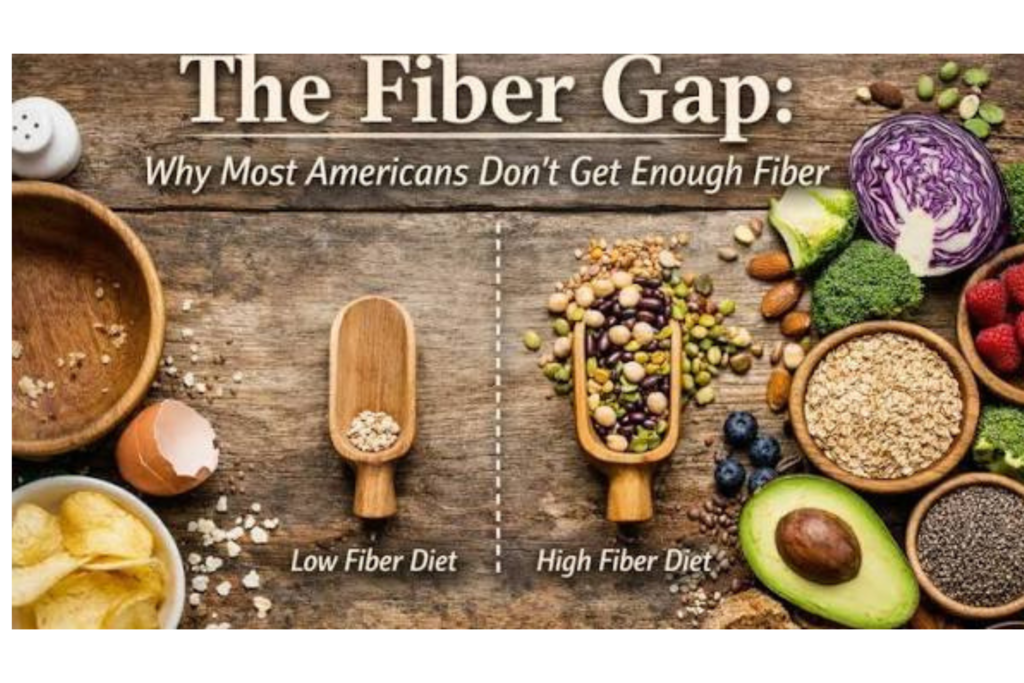
What Counts as “Enough” Fiber — And Why Almost Nobody Hits It
Health authorities generally recommend somewhere around 25 grams a day for women and 30–38 grams for men, depending on age and calorie needs. The typical adult in a Western diet eats roughly 10 to 15 grams. That’s not a small shortfall — it’s often a 50 to 60 percent deficit, day after day, compounding over a lifetime.
Compare that to protein, where most people who eat normally are actually close to their needs, or even over them. Fiber is different. It doesn’t show up naturally in the foods that dominate modern eating — white bread, packaged snacks, fast food, refined pasta, sugary cereal, most restaurant meals. Those foods have had the fiber-rich parts of the plant (the skin, the bran, the pulp) stripped out during processing, because fiber-rich food tends to be less shelf-stable, less sweet, and less immediately satisfying in the way manufacturers optimize for.
So the fiber gap isn’t really a knowledge problem. Most people know vegetables and whole grains are “good for them.” It’s a structural problem — it’s baked into what’s cheap, fast, and available.
Why This Particular Gap Matters So Much
Fiber doesn’t get the same spotlight as protein or sugar, but the research behind it is some of the most consistent in all of nutrition science. A few things make it uniquely important.
It’s Food for Your Gut Bacteria — Not Just “Roughage”
For decades, fiber was framed mainly as something that helps you stay regular. That’s true, but it’s a small part of the story. The bigger picture is that fiber — specifically the fermentable kind found in oats, beans, onions, garlic, and many fruits — is the primary fuel source for the trillions of bacteria living in your colon.
When those bacteria ferment fiber, they produce compounds called short-chain fatty acids, including one called butyrate. Butyrate is the preferred energy source for the cells lining your gut, helps maintain the gut barrier, and has anti-inflammatory effects that reach well beyond the digestive tract. When fiber intake is chronically low, this fermentation process slows down, the gut lining gets less of the fuel it depends on, and the balance of bacteria can shift toward less favorable species. This is one of the more compelling explanations for why low-fiber, highly processed diets are so consistently linked to digestive complaints, low-grade inflammation, and even mood and energy issues that seem to have nothing to do with digestion on the surface.
It Slows Down Everything Sugar-Related
Fiber, particularly the soluble type found in oats, beans, apples, and psyllium, forms a gel-like substance in the digestive tract. This slows the rate at which sugar from a meal enters the bloodstream, which means smaller blood sugar spikes and a gentler insulin response. For anyone dealing with energy crashes after meals, sugar cravings an hour after eating, or concerns about metabolic health, this single mechanism does a lot of quiet, unglamorous work.
It’s One of the Strongest Predictors of Long-Term Heart and Metabolic Health
Large, long-running population studies have repeatedly found that people with higher fiber intake have meaningfully lower rates of heart disease, type 2 diabetes, and certain cancers, including colorectal cancer. Soluble fiber in particular has a well-documented cholesterol-lowering effect, binding to cholesterol-containing compounds in the digestive tract and helping remove them from the body before they’re absorbed.
It Makes You Full Without a Fight
Fiber-rich foods take up physical space in the stomach, digest slowly, and trigger fullness signals more effectively than refined, low-fiber foods with the same number of calories. This is a big part of why a bowl of oatmeal with berries keeps you satisfied for hours while a pastry with a similar calorie count leaves you hungry again within ninety minutes. If weight management is a goal, fiber is arguably one of the most underrated tools available — it works with appetite instead of fighting it.
The Signs the Gap Might Be Affecting You
Because fiber deficiency doesn’t announce itself the way a vitamin C deficiency might, it tends to show up as a cluster of vague, easy-to-dismiss symptoms:
- Irregular digestion — constipation, bloating, or a digestive system that feels unpredictable
- Energy crashes an hour or two after meals, especially carb-heavy ones
- Feeling hungry again shortly after eating, even after a decent-sized meal
- Sugar or snack cravings that show up mid-afternoon like clockwork
- Cholesterol numbers that creep up despite a diet that “looks” reasonably healthy on paper
None of these are proof of low fiber intake on their own, but if several of them sound familiar, it’s worth looking at how much of your plate is actually coming from whole, minimally processed plant foods versus refined and packaged ones.
Why “Just Eat More Vegetables” Doesn’t Actually Close the Gap for Most People
This is where most fiber advice falls short. Telling someone to “eat more vegetables” is true but not very useful, because the fiber gap usually isn’t caused by a total absence of vegetables — it’s caused by portion sizes and meal structure that quietly exclude fiber from most meals.
A person can eat a garden salad at lunch and still land nowhere near their fiber target, because a few cups of lettuce contain surprisingly little fiber compared to something like lentils, chickpeas, or a pear. The foods with the highest fiber density per calorie tend to be legumes, whole intact grains, and fruit with the skin on — not leafy greens, which are mostly water.
This is why closing the fiber gap is less about “adding vegetables” as a vague concept and more about deliberately building meals around a handful of specific, high-yield foods.
The Foods That Actually Move the Needle
Some foods carry far more fiber per typical serving than others. A short list of genuinely high-impact options:
- Legumes (lentils, black beans, chickpeas, kidney beans) — often 7 to 15 grams per cooked cup, plus a meaningful dose of protein
- Whole intact grains (oats, barley, quinoa, farro) — roughly 4 to 8 grams per cooked cup
- Berries — around 6 to 8 grams per cup, more than most other fruit
- Pears and apples with the skin on — roughly 4 to 6 grams each
- Chia and flax seeds — about 5 grams per tablespoon, easy to add to almost anything
- Avocado — around 10 grams per whole fruit
- Cruciferous vegetables (broccoli, Brussels sprouts) — 4 to 5 grams per cooked cup
Notice the pattern: legumes and whole intact grains do the heaviest lifting, not leafy greens. A single cup of lentils can contain more fiber than an entire large salad.
A Realistic Way to Close the Gap (Without Counting Grams Forever)
Hitting 25 to 35 grams a day sounds intimidating until you break it into a few repeatable habits rather than a strict count.
1. Put a Legume or Whole Grain in at Least Two Meals a Day
This is the single highest-leverage change available. Swap white rice for farro or quinoa. Add a scoop of lentils or black beans to soups, tacos, or grain bowls. Start the day with oats instead of cereal. This one habit alone can close most of the average fiber gap.
2. Keep the Skin On
Apples, pears, potatoes, cucumbers — the skin holds a disproportionate share of the fiber. Peeling produce out of habit, rather than necessity, quietly strips out a nutrient most people are already short on.
3. Upgrade One Snack a Day
Trade a packaged snack bar or chips for a handful of nuts with fruit, or roasted chickpeas, or an apple with peanut butter. Snacks are usually the lowest-fiber, most processed part of a day’s eating — and the easiest place to make an effortless swap.
4. Add Seeds to Things You Already Eat
A tablespoon of chia or ground flax stirred into yogurt, oatmeal, or a smoothie adds roughly 5 grams of fiber without changing the meal in any meaningful way. It’s one of the lowest-effort additions in all of nutrition.
5. Increase Gradually and Drink Water Alongside It
One caveat worth taking seriously: ramping up fiber intake too quickly can cause bloating, gas, or discomfort, especially if your gut bacteria aren’t used to fermenting that much of it yet. Increase over two to three weeks rather than overnight, and make sure water intake goes up alongside fiber intake — fiber needs adequate fluid to do its job properly, particularly the insoluble type found in whole grains and vegetable skins.
A Sample Day That Closes the Gap Without Feeling Like a Diet
- Breakfast: Oats made with a tablespoon of chia seeds and a cup of berries — roughly 12 to 14 grams of fiber before 9 a.m.
- Lunch: A grain bowl with farro or quinoa, roasted vegetables, and a half-cup of chickpeas — another 10 to 12 grams
- Snack: An apple with the skin on and a small handful of almonds — 5 to 6 grams
- Dinner: A normal meal with a side of lentils, black beans, or a cup of broccoli swapped in for a refined starch — another 6 to 10 grams
Add it up, and that’s a day comfortably in the 30-plus gram range, without a single moment that feels like “diet food.” Nothing here requires giving up meat, dairy, or the meals you already enjoy — it’s about making sure fiber-dense foods have a seat at the table instead of an occasional cameo.
The Bigger Picture
The fiber gap doesn’t get the attention it deserves because it isn’t dramatic. Nobody feels an immediate crash from missing fiber the way they might from skipping a meal entirely. It works quietly, over years, through the gut, through blood sugar stability, through cholesterol, through how full and satisfied you feel after eating. That’s exactly why it’s worth paying attention to — it’s one of the few nutrition gaps where a handful of small, boring, repeatable changes genuinely compound into a very different health trajectory over time.
You don’t need a supplement, a new diet identity, or a fiber-tracking app. You need lentils in more meals, the skin left on your fruit, and one better snack a day. That’s the whole strategy — and it’s one of the rare cases in nutrition where the simplest advice also happens to be the most evidence-backed.
This article is for general educational purposes and isn’t a substitute for personalized medical or nutritional advice. If you’re making major dietary changes, especially due to a digestive condition, talk with a doctor or registered dietitian first.