
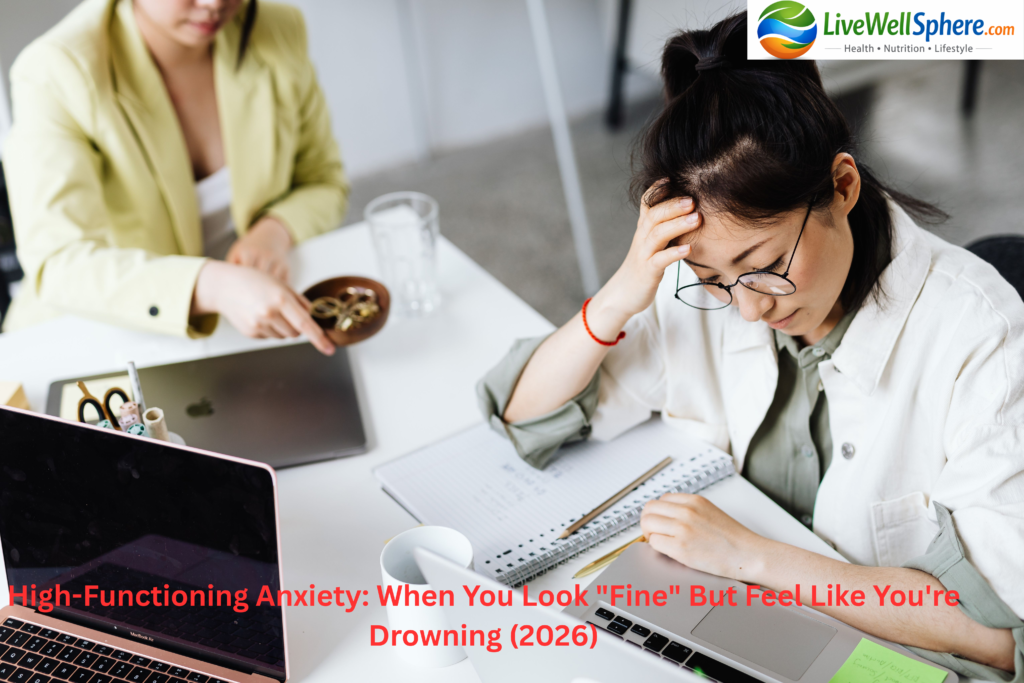
High-Functioning Anxiety: When You Look “Fine” But Feel Like You’re Drowning
You get to work early. You answer every email the same day. Your calendar is color-coded, your to-do list is done before lunch, and everyone around you thinks you have it together.
Nobody sees the racing thoughts at 2 a.m. Nobody sees you rereading a text five times before hitting send, or replaying a two-minute conversation from Tuesday like it’s a courtroom transcript. Nobody sees the tight jaw, the stomach that’s never quite settled, the relief that lasts about four minutes after you finish the thing you were dreading — before the next worry quietly takes its seat.
This is high-functioning anxiety, and it might be the most overlooked mental health pattern of 2026. Not because it’s rare — because it’s disguised as competence.

What Is High-Functioning Anxiety, Really?
Here’s the part that surprises most people: high-functioning anxiety isn’t an official diagnosis. You won’t find it listed in the DSM-5, the manual clinicians use to diagnose mental health conditions. It’s a term that grew out of everyday language and social media, used to describe something very real — anxiety that drives performance instead of shutting it down.
Most people picture anxiety as visible distress: someone who avoids parties, cancels plans, or struggles to leave the house. High-functioning anxiety looks nothing like that from the outside. It looks like the coworker who never misses a deadline. The parent who never forgets a permission slip. The friend who always “seems so put together.” Underneath, many of these people would meet the clinical criteria for generalized anxiety disorder — they just channel that anxious energy into achievement, over-preparation, and control, rather than withdrawal.
The anxiety doesn’t go away because you’re succeeding. It just goes quiet in public and loud in private.
Why It’s So Easy to Miss — Even in Yourself
High-functioning anxiety hides in plain sight for a simple reason: it produces results. When anxiety pushes you to double-check your work, arrive early, and plan for every scenario, the outcome often looks like discipline, not distress. You get praised for it. You get promoted because of it. So why would you question something that appears to be working?
The problem is that “working” and “sustainable” are not the same thing. A body running on chronic low-level stress isn’t thriving — it’s compensating. And because the coping mechanism is invisible, the people who need support the most are often the last to ask for it. They tell themselves things like “it’s not that bad,” “other people have it worse,” or “I just need to push through a bit longer.” Mental health support isn’t reserved for the moment everything falls apart — but that’s exactly the belief that keeps so many people quietly white-knuckling their way through the week.
The Signs You Might Be Overlooking
1. A Mind That Never Fully Powers Down
Racing thoughts are one of the clearest markers. You replay conversations searching for something you said wrong. You mentally rehearse tomorrow’s meeting while you’re supposed to be relaxing tonight. Even during downtime, part of your brain stays on watch, scanning for what could go wrong next. This isn’t overthinking in the casual sense — it’s a nervous system that hasn’t learned how to stand down.
2. Physical Symptoms You’ve Blamed on Everything Else
Long before many people connect their symptoms to anxiety, they’ve already blamed them on poor sleep, bad posture, or “just stress.” Common physical signs include a tight jaw or clenched teeth, tension headaches, an unsettled stomach, muscle tightness in the neck and shoulders, fatigue that doesn’t improve with rest, and a heart that races for no obvious reason. If you’ve been to a doctor for these symptoms and left without a clear explanation, anxiety is worth considering as a piece of the puzzle.
3. Perfectionism That Feels Like a Requirement, Not a Preference
There’s a difference between wanting to do good work and feeling like anything less than flawless is unacceptable. High-functioning anxiety often shows up as unrealistically high personal standards, paired with real distress when those standards aren’t met — even by small margins that nobody else would notice.
4. Difficulty Saying No
Overcommitting is common, not because you don’t value your time, but because saying no can trigger a wave of guilt or a fear of letting someone down. Over time, this creates a schedule that’s technically impressive and personally unsustainable.
5. Brief Relief, Then Immediately Onto the Next Worry
This is one of the quieter, more painful signs. You finish the project, pass the exam, or get through the event you were anxious about — and for a few minutes, you feel okay. Then, almost on schedule, your mind finds the next thing to worry about. The relief never has time to become rest.
6. Trouble Shutting Off at Night
Even when the body is exhausted, the mind won’t cooperate. Falling asleep can take a long time because you’re replaying the day or planning tomorrow. Waking up in the middle of the night with a racing mind, or waking early feeling wired instead of rested, is common. This creates a frustrating cycle: poor sleep worsens anxiety, and anxiety worsens sleep.
7. Emotional Flatness Between Achievements
Some people describe feeling strangely numb rather than proud after hitting a goal. The emotional payoff feels muted, almost like the win doesn’t count once it’s happened, because the anxious mind has already moved on to defending the next milestone.
Why Ignoring It Has a Real Cost
It’s tempting to treat high-functioning anxiety as a harmless personality quirk — “I’m just a planner,” “I just care about doing things right.” But the body doesn’t experience chronic low-grade anxiety as harmless. The stress response is designed for short bursts, not for running quietly in the background all day, every day.
Over months and years, that constant activation is linked to real physical costs: elevated cortisol, disrupted sleep, a weakened immune system, digestive issues, and increased strain on the cardiovascular system. Psychologically, it often ends in burnout — a state of emotional and physical depletion that can arrive suddenly, even though it’s been building for a long time. The engine that once ran on anxious energy eventually runs out of fuel, and the crash can feel confusing precisely because everything looked fine right up until it wasn’t.
FAQ:
Q: Is high-functioning anxiety a real diagnosis?
A: No — it’s not in the DSM-5, but it describes a very real pattern many clinicians recognize: anxiety that drives performance instead of visible distress.
Q: Can high-functioning anxiety turn into burnout?
A: Yes. The two often overlap, and unmanaged high-functioning anxiety is one of the more common paths into burnout.
Q: How is it different from generalized anxiety disorder (GAD)?
A: Many people with high-functioning anxiety would meet the clinical criteria for GAD — the “high-functioning” part just describes how it shows up outwardly.
How to Start Loosening Its Grip
You don’t need to overhaul your entire life to make progress here. Small, consistent shifts tend to matter more than dramatic ones.
Name it honestly. Simply recognizing “this is anxiety, not just ambition” is often the first real turning point. It reframes the racing thoughts and physical tension as symptoms worth addressing, rather than a personality trait to defend.
Practice sitting with “good enough.” Deliberately submit the email without rereading it a sixth time. Leave a task at 90% instead of 100% once in a while. This isn’t about lowering your standards permanently — it’s about proving to your nervous system that imperfection isn’t catastrophic.
Build in real recovery, not just rest that looks like rest. Scrolling your phone on the couch isn’t the same as your nervous system actually downshifting. Look for activities that genuinely calm your body: slow breathing, a short walk without your phone, time in nature, or simply sitting in silence for a few minutes without a task attached to it.
Get curious about your “no.” Before agreeing to something new, pause and ask whether you’re saying yes because you want to, or because saying no feels unbearable. Even noticing the pattern is progress.
Protect your sleep like it’s non-negotiable. A consistent wind-down routine, a cooler room, and cutting off screens even 20 minutes earlier can make a measurable difference in how racing your mind feels at bedtime.
Talk to someone qualified. Because high-functioning anxiety often meets the criteria for generalized anxiety disorder, therapy approaches such as cognitive behavioral therapy can be genuinely effective — not just for reducing symptoms, but for helping you unlearn the belief that anxiety is the price of success. A doctor can also help rule out or address physical symptoms that may be connected.
You Don’t Have to Wait Until You Break Down
One of the most damaging myths about mental health is that support is only for people who are visibly struggling. If your life looks successful on paper but feels exhausting to live, that counts. You don’t need a crisis to justify asking for help — you’re allowed to want to feel calm, not just capable.
Being “fine” on the outside was never supposed to be a life sentence.
NOTE: This article is for general educational purposes and isn’t a substitute for professional medical or mental health advice. If anxiety is affecting your daily life, consider speaking with a licensed therapist or your doctor.