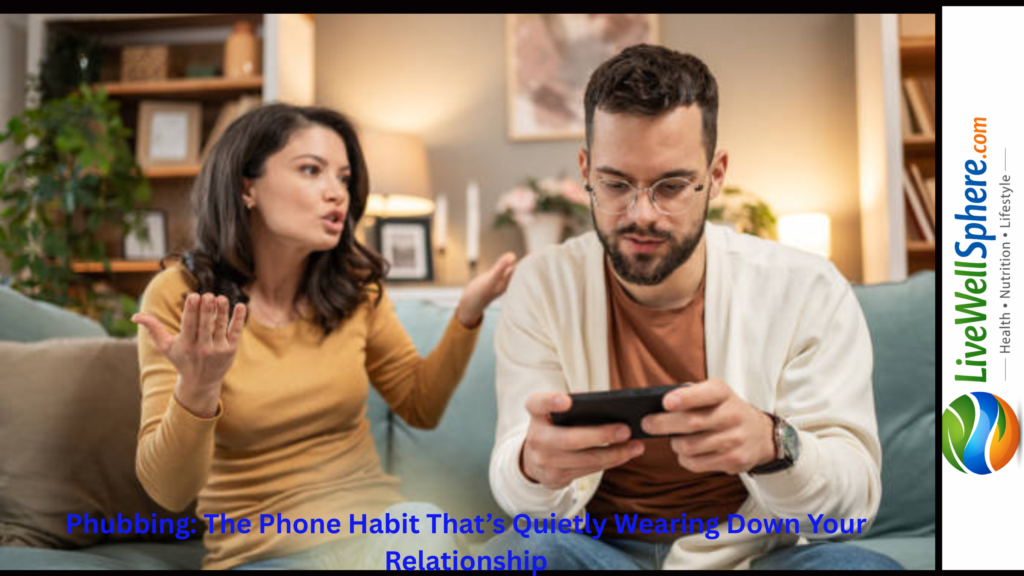
Phubbing: The Phone Habit That’s Quietly Wearing Down Your Relationship
Your partner is talking about their day. Mid-sentence, their phone buzzes. Their eyes drop. Yours probably do too, eventually — not because either of you means to be rude, just because that’s what phones on a table do now. There’s a word for this: phubbing, short for phone snubbing, coined back in 2012 by an Australian ad agency campaign. The behavior is older than the word, but it’s only gotten more common since.
It’s worth being precise about what counts. Phubbing isn’t only “ignoring someone to take a call.” Researcher Elaine Kasket, a cyberpsychologist who’s written on the topic, points out that the most familiar examples include checking notifications mid-conversation, scrolling during meals, half-listening while texting, and reaching for the phone during quiet or emotionally loaded moments. None of these feel dramatic in isolation. That’s exactly why they add up.

How Common Is This, Actually?
This isn’t a fringe complaint. Baylor University researchers Meredith David and James Roberts found that more than 46% of people surveyed said they’d been phubbed by their own partner, and almost a quarter said it had led to more fighting and less relationship satisfaction.
The research since then has only built on that picture. A 2025 meta-analysis pulling together 52 studies and nearly 20,000 participants confirmed that partner phubbing reliably correlates with worse relationship outcomes, though the size of the effect varies by population and study design. A separate 2025 study of 361 adults found something more specific about why it hurts: partner phubbing directly lowered trust, and that drop in trust — not the phubbing itself — was what fully explained the drop in relationship satisfaction. In other words, it’s not the phone check itself that does the damage. It’s what the phone check quietly tells your partner about where they rank.
Not every study agrees on how severe this is. A 2025 daily-diary study from the University of Southampton tracked people for 10 days and found phubbing didn’t directly reduce relationship satisfaction across the board — but it did make anxiously attached partners more prone to resentment, lower self-esteem, and a tendency to seek validation elsewhere after being phubbed. So the effect isn’t uniform. It seems to hit hardest for people who are already more sensitive to signs of rejection — which, in a long relationship, is probably most of us at one time or another.
Why a Small Habit Does Real Damage
Here’s the part that’s easy to miss: you don’t need to be staring at your phone for it to register. Kasket notes that even the visual presence of a phone in the room has been shown to reduce feelings of closeness and perceived empathy between people talking. A phone face-up on the table is a standing reminder that attention could leave at any second — and apparently, that reminder alone is enough to flatten a conversation.
There’s also a useful frame from outside the phubbing research entirely: the Gottman Institute’s long-running work on what they call “bids for connection” — small moments like a comment about the weather, a held-out hand, a “look at this.” Couples who reliably notice and respond to these bids stay together longer; couples who consistently miss them don’t. A phone doesn’t have to cause a fight to do damage. It just has to make you miss the bid.
What Actually Helps
The advice that shows up across therapists, researchers, and relationship organizations like the One Love Foundation is less about willpower and more about removing friction:
Put physical distance between you and the phone, not just intention. Self-control under a buzzing phone is a losing bet most days. A drawer in another room beats a phone face-down on the same table — face-down still means it’s in reach.
Protect two specific windows: meals and the first half-hour after reuniting. You don’t need an all-day ban to see a difference. These two windows carry disproportionate weight for how connected a day feels.
Notice the “figurative” version too. You can put the phone away and still be phubbing — composing the text in your head, waiting for your turn to talk instead of actually listening. The device isn’t always the problem; divided attention is.
Say what you noticed, not what you assume. “You checked your phone three times during that” lands very differently than “you never listen to me.” One’s an observation. The other’s an accusation, and it tends to get a defensive answer instead of a real one.
If you’re the one who got phubbed, say so in the moment. Most phubbing isn’t malicious — it’s reflexive. A simple “hey, I lost you for a second” usually gets a genuine apology and a put-down phone, not a fight.
None of this requires becoming a person who’s allergic to technology. The research isn’t saying phones ruin relationships. It’s saying that trust erodes a little each time someone learns they’re competing with a notification — and that the fix is usually smaller and more boring than people expect: less access, more noticing, a phone that’s somewhere else for twenty minutes at dinner.
Conclusion
Phubbing isn’t a character flaw, and it isn’t really about phones being bad. It’s about attention being a finite thing, and most of us spending it on autopilot. The research is consistent on one point even where it disagrees on others: what erodes a relationship isn’t a single glance at a screen. It’s the slow accumulation of moments where a partner quietly learns they’re not the priority — and starts adjusting their trust accordingly.
That’s also the good news. Because the damage is cumulative, the fix doesn’t have to be dramatic. You don’t need a digital detox or a flip phone. You need a drawer across the room during dinner, a habit of naming it when you notice it, and enough self-awareness to catch yourself before your partner has to. Couples who treat this as a small, fixable habit — not a referendum on the relationship — tend to fix it. The ones who let it become “just how things are now” are the ones the research keeps finding in the lower-satisfaction column.
Pay attention to who’s getting your attention this week. It’s a smaller ask than it sounds like, and it’s the one the data keeps pointing back to.